CIAM Is Not Workforce IAM: Designing External Identity That Converts and Complies
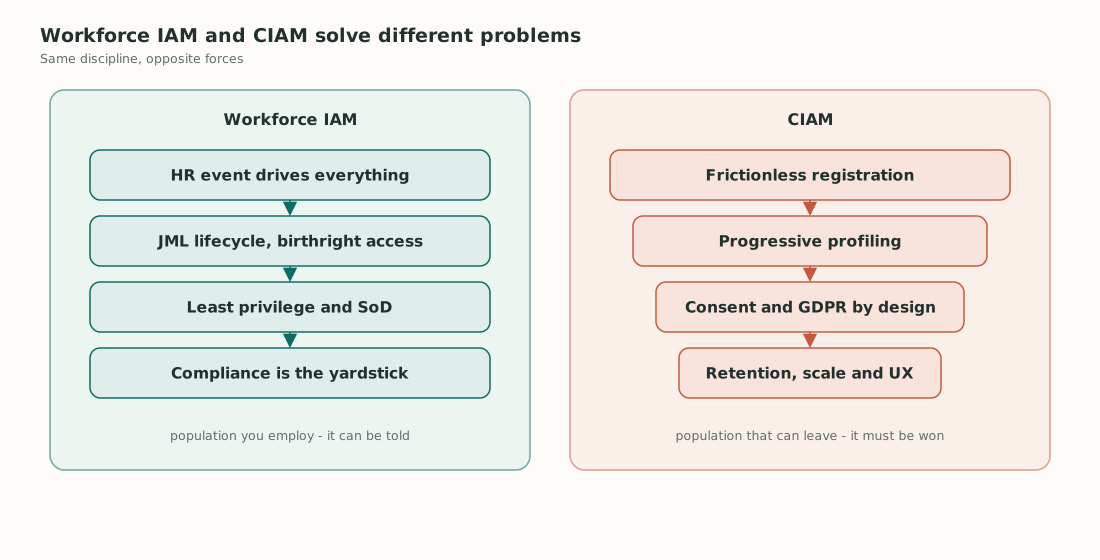
The fastest way to fail a customer identity programme is to staff it exclusively with workforce IAM thinking. I have led CIAM and external identity architecture across consumer-facing and partner-facing platforms, and the disciplines overlap far less than the org chart assumes.
The fundamental asymmetry
Workforce identity is coercive: employees complete enrolment because payroll depends on it. Customer identity is voluntary: every ounce of friction is measured in abandonment. That inverts the design priorities - the workforce architect optimises for control and assurance; the CIAM architect optimises for conversion within a risk envelope. Both are security work. Only one of them has a funnel metric.
Design journeys, not directories
CIAM deliverables are user journeys: registration, sign-in, recovery, consent, profile management, delegation (a customer authorising a family member, a business authorising an accountant). Each journey is a designed artefact with security controls placed where risk actually accrues:
- Progressive profiling - collect the minimum at registration, ask for more only when a transaction justifies it.
- Risk-based step-up - low-friction entry, stronger verification triggered by value and anomaly, not applied uniformly.
- Account recovery as an attack surface - recovery flows are where account takeover lives; design them with the same rigour as authentication itself.
- Federation options - social and external IdP sign-in where the audience expects it, with a clear identity-linking model underneath.
Consent and privacy are architecture
Under GDPR, consent is not a checkbox pattern - it is a data architecture requirement. Purpose-bound consent must be captured, versioned, revocable, and enforced downstream: marketing systems, analytics and data platforms should consume consent state as an attribute, not assume it. Data minimisation and retention rules belong in the identity design, because the identity platform is where the personal data enters.
B2B is its own discipline
Partner identity sits between the two worlds: organisations rather than individuals, federation trust rather than password databases, and invitation, sponsorship and lifecycle governance so that guest access ends when the relationship does. Un-governed guest populations are the workforce equivalent of leavers with live accounts - and every audit finds them.
One platform decision, made deliberately
Whether you build on Entra External ID, Azure AD B2C, or another CIAM stack, make the platform serve the journey designs - not the other way round. The journeys, the consent model and the risk envelope are your architecture; the product is an implementation detail you should be able to defend replacing.
Have an identity challenge worth solving?
I take a small number of freelance and contract engagements each year.