Fine-Grained Access Control: From Front-Door Security to Decisions That Understand Context
Walk through most enterprise estates and you will find the same authorisation pattern, repeated everywhere: a user authenticates, a coarse role or group decides whether they may open the application, and from that point onwards the application trusts them with everything inside it. The front door is guarded; the rooms are not. Fine-grained access control - FGAC - is the discipline of pushing authorisation past the front door, down to the record, the row, the field, the document and the action, evaluated in context at the moment of the request.
This article sets out how I frame FGAC for clients: what it actually is, why coarse-grained models quietly fail at scale, the architecture that makes fine-grained decisions sustainable, and a pragmatic adoption path that does not require boiling the ocean.
Coarse-grained control fails quietly, not loudly
The failure mode of front-door authorisation is not a breach headline - it is accumulation. An application grants “Finance User” access to the finance system; within the system, that role can see every entity, every cost centre, every payroll record, because modelling anything finer was somebody else’s problem during delivery. Multiply that across a few hundred applications and a decade of joiners, movers and leavers, and you arrive at the estate most access reviews actually reveal: thousands of people technically entitled to data they have no business need to see, with no mechanism to express the distinction.
Regulators have noticed. Data protection regimes expect access limited to purpose, not to application membership. Cyber insurers ask about least privilege and mean it at the data layer. And attackers exploit exactly this gap - a phished account with a coarse role is a skeleton key, because nothing behind the front door asks a second question.
What “fine-grained” actually means
FGAC is not one technology; it is a decision granularity. A useful way to think about it is three questions layered on top of authentication:
- Object-level - can this identity access this specific record, document, case or resource? Not “the CRM” but “this customer’s file”.
- Row and field-level - within a dataset the identity can query, which rows are visible, and which columns or attributes are masked, redacted or transformed? A claims handler sees claims in their region; a data analyst sees the table with national-insurance numbers masked.
- Action and context-level - is this operation (read, export, approve, delete) permitted for this identity, on this resource, under current conditions - device posture, location, time, risk score, delegation chain?
The moment you frame requirements this way, role-based models alone stop being sufficient. Roles answer “who are you”; fine-grained decisions also need “what is this resource, what are its attributes, what is the relationship between you and it, and what is happening right now”. That is attribute-based and policy-based access control - ABAC and PBAC - and, increasingly, relationship-based access control (ReBAC) for structures like “manager of”, “owner of”, “member of this matter team”, which relational hierarchies express more naturally than attribute soup.
The architecture: externalise the decision
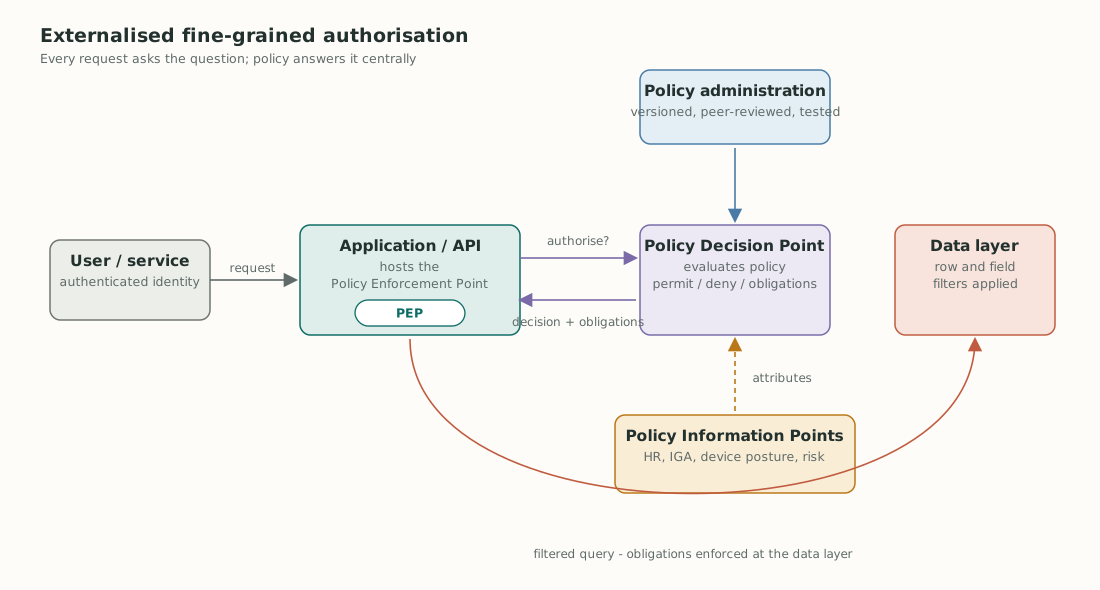
The single most important design choice in FGAC is where the decision lives. Embedding authorisation logic inside each application - the historic default - guarantees divergence: a thousand bespoke permission engines, none auditable, none consistent, each rewritten at every upgrade. The sustainable pattern externalises authorisation into the policy decision model that Zero-Trust practice has standardised: applications and data platforms host Policy Enforcement Points (PEPs) that ask a central Policy Decision Point (PDP) “may this identity do this to that, in this context”, receive permit, deny or permit-with-obligations, and enforce the answer. Policy Information Points supply the attributes; a Policy Administration Point governs the policy lifecycle.
This is the same PDP/PEP thinking I have written about for AI systems, applied to data access generally - and that is not a coincidence. Retrieval-augmented generation made FGAC urgent in a way a decade of compliance findings never quite managed: a RAG pipeline that indexes everything into one vector store bypasses every access control the source systems ever had. The fix is the same discipline - retrieval filtered by the requesting user’s entitlements, row and field filters derived from PDP obligations, so a query on behalf of a user can only surface what that user is entitled to see. If your organisation is deploying AI assistants over corporate data, FGAC has stopped being an aspiration and become a prerequisite.
On standards and tooling: XACML 3.0 remains the conceptual reference model even where its XML syntax is unloved; modern engines - Open Policy Agent, AWS Cedar, and the platform-native filters in the major data clouds - implement the same architecture with friendlier policy languages, and OpenID’s AuthZEN work is converging the PEP-to-PDP interface so enforcement points become portable. The engine matters less than the pattern: decisions externalised, policies versioned and testable, every decision logged with the identity, the resource, the context and the outcome.
Making it real without boiling the ocean
Every FGAC programme I have seen fail tried to model the entire enterprise’s entitlements in one heroic effort. The ones that succeed are ruthlessly incremental:
- Anchor on authoritative attributes first. Fine-grained decisions are only as good as the data feeding them. Department, employment status, location, clearance, team membership - sourced from HR and the IGA platform, not hand-maintained in application databases. This is why FGAC sits downstream of a healthy joiner-mover-leaver architecture: stale attributes make fine-grained policy confidently wrong.
- Pick one high-value, well-bounded domain. Regulated data with an obvious owner - payroll, health records, case files, M&A deal rooms. Model its policies, wire one PDP, prove the audit story, then expand.
- Write policies as products, not tickets. Versioned, peer-reviewed, tested against decision fixtures before release - the same rigour applied to Conditional Access frameworks, one layer deeper.
- Design for obligations, not just permit/deny. The most valuable fine-grained outcomes are conditional: permit with masking, permit with watermarking, permit with step-up authentication, permit with logging obligations. Enforcement points must be able to honour them.
- Instrument before you enforce. Run new policies in monitor mode against live traffic, compare outcomes with current behaviour, and take the surprises to the data owners - there will be surprises.
Where this lands strategically
Fine-grained access control is the natural end-state of three converging pressures: Zero-Trust’s insistence that every request be evaluated in context, regulators’ insistence that access track purpose, and AI’s habit of aggregating data faster than legacy controls can follow. Organisations that treat FGAC as an application feature will keep re-buying it badly, one system at a time. Organisations that treat it as an identity-domain capability - authoritative attributes, externalised decisions, governed policy - build it once and apply it everywhere it matters.
The front door still needs a lock. But the estates that hold up under audit, incident and AI adoption are the ones where every room asks its own question.
Have an identity challenge worth solving?
I take a small number of freelance and contract engagements each year.